Simplifying your future
Solving Military-Avionics DC/DC Power Challenges with Modularity (Part 1).
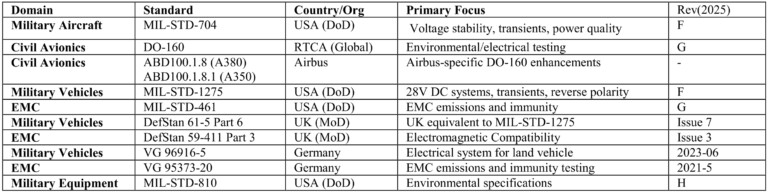
While power electronics designers are skilled at designing power supplies, they often lack the knowledge necessary to meet military or aerospace standards. This series of four articles provides guidance to help designers understand standard parameters and presents best practices for the effective design of aerospace and military-grade power supplies. This first part provides a comprehensive list of key stress limits, which will serve as an essential technical reference.
By Christian Jonglas, Technical Support Manager, Gaia Converter
Military and avionics applications demand more powerful power supplies. This is mainly due to two factors: first, many functions that were in the past performed using mechanical or hydraulic methods are now fully electric; and second, emerging technologies such as high-power processing like mission critical computer, software defined radars directed-energy weapons (DEW) or any AI based electronic device require significantly more energy. This increase in demand for electrical energy is illustrated by the following examples: the Dassault Mirage F1 was equipped with 2 15 kVA electrical generators [1.1], whereas the new Dassault Rafale is equipped with a 80 kVA generator [1.2]. In another example, the F16 Fighting Falcon uses a 40 /60 KVA [1.3] generator, while the latest F35 Lightning II is equipped with a system that can generate up to 160 kVA [1.4].
Military vehicles are also keeping pace, with hybridization leading to increasingly powerful electric power sources.
Given these figures, it is not surprising that electronic design engineers are required to produce new projects following the SWaP (Size Weight and Power) trend for lower size, lower weight and higher power. The challenge of developing modern applications is also exacerbated by the fact that power supplies must comply with stringent standards. In most cases, leveraging a modular power architecture based on COTS (Commercial Off-The-Shelf) components remains the simplest and most effective approach. This article will provide a comprehensive review of standards to design power supplies for military and avionic, and suggest some examples of functions designed with discrete components, and their counterpart using COTS-based modular power supplies such as those proposed by Gaïa-Converter.